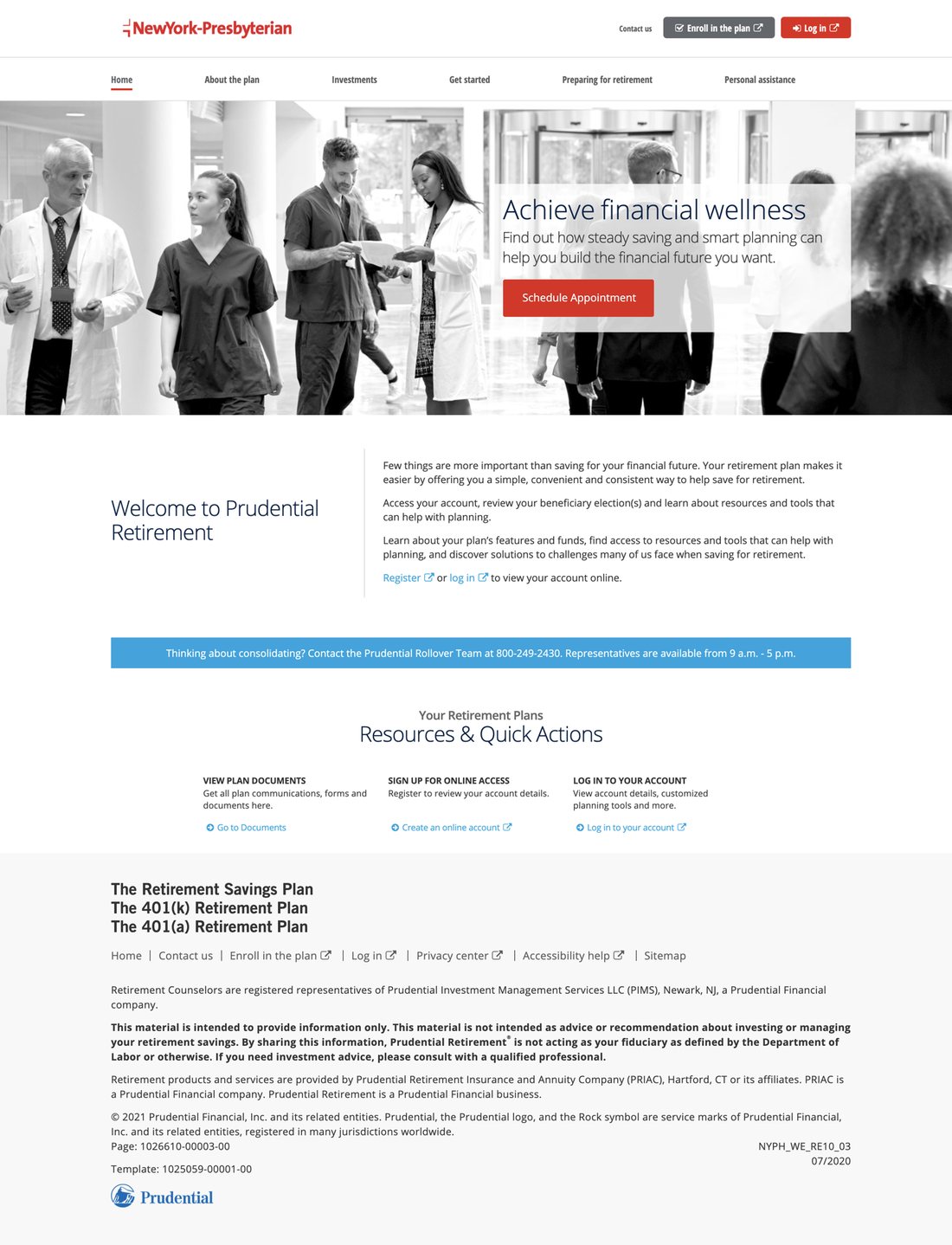
The situation
NewYork-Presbyterian was moving its retirement program to Prudential, and the conditions made it hard. Five legacy 403(b) plans could only transfer participant by participant, which put about $200M in rollover assets in play. That ran alongside plan-level transfers and several blackout dates. Employees, many of them clinicians working long shifts, had narrow windows to act in and needed to know what they were doing.
My role
I led the experience end to end: information architecture, content, interaction design, and accessibility. I also designed the Personal Assistance experience. My partners were client stakeholders, the retirement counselors themselves, analytics, and technology.
My approach
- Built a participant journey that made the options, the timelines, and the blackout dates legible, so people weren't guessing at a decision this size.
- Designed the Personal Assistance page, video included, to connect participants with a counselor when the site wasn't enough.
- Held everything to enterprise WCAG standards using consistent, reusable patterns.
- Watched behavioral analytics and client-satisfaction signals, and kept refining.
Designed for reuse
The multiple-account component at the center of this wasn't built for NewYork-Presbyterian alone. It was designed to flex across plan counts, blackout windows, and transfer types, and it went on to serve other client sites with different constraints. That's the systems thinking behind the award, and it's the thread running through the rest of this portfolio.
Outcome
The redesign won Pensions & Investments' 2020 Eddy Award and carried NewYork-Presbyterian through the move to Prudential, guiding participants through a multi-plan, multi-blackout consolidation involving roughly $200M in participant-level rollover assets.