The situation
A hardship withdrawal is one of the most consequential requests a retirement participant can make, and participants often make one during a period of financial strain. An incomplete request delays help for them and creates rework, follow-up calls, and risk for the business.
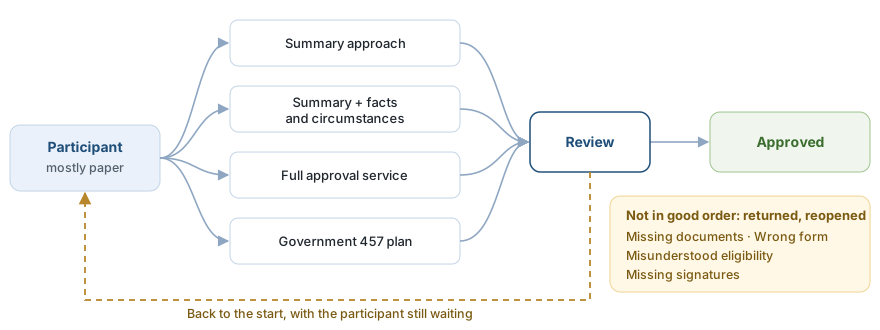
I inherited wireframes from 2019. They mapped four request paths: a summary approach, a summary approach with facts and circumstances, a full approval service, and a government 457 plan flow. Much of the real process still ran on paper, and requests were often returned as NIGO for several reasons: missing documents, the wrong form, misunderstood eligibility, and missing signatures.
SECURE 2.0 then changed the requirements and allowed participants to self-certify their hardship. That gave the team an opportunity to rethink the full request rather than simply moving the paper form online.
Before
 (opens full size in a new tab)
My role
This was a highly visible, phased project at Empower. I led the end-to-end design of the experience: how a participant moves through the request, makes each decision, and confirms what they selected along the way. After I became design lead in December 2024, I directed the day-to-day design work of two senior designers through the later phases.
My approach
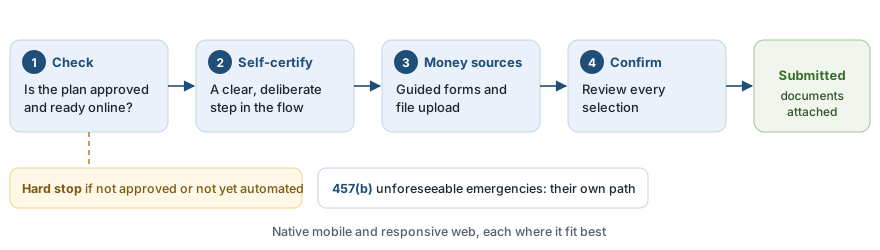
- Hard-stop messaging for plans that weren't approved for the online request or weren't yet fully automated.
- Self-certification as a clear, deliberate step in the flow.
- Money source selection with guided forms and file upload, so required documentation travels with the request.
- Native mobile and responsive flows, each where it fit best, so participants can complete the request on the device that works best for them.
- 457(b) unforeseeable emergency withdrawals, which follow different rules from 401(k) hardships and needed their own path.
After
 (opens full size in a new tab)
Working across the business
I partnered with editorial, compliance, legal, product, value stream leads, and engineering. The collaboration was steady and constructive, with ongoing clarification on what each rule meant in practice, how participants would read each sentence, and what engineering could support. Product owners led the compliance and legal reviews. I attended most of them, and when I couldn't, I captured the outcomes and incorporated every edit into the final design, so nothing was lost between review and build.
How we validated it
We usability tested the experience early. Findings pointed to further iterations, and within our resources, the team completed one focused round of changes. We also tested the flows for accessibility with WAVE.
Designed for reuse
I actively maintained, informed, and contributed to the Money Out micro design system that these flows drew from.
Outcome
Phase 1 launched in April 2023, followed by iterative releases that streamlined the experience. The result was fewer paper forms, fewer NIGO submissions, and fewer calls. Exact figures are proprietary to Empower.
Lessons learned
- Every NIGO submission told me something. Missing documents, the wrong form, a misunderstood eligibility rule, a missing signature: each one pointed to a decision the experience wasn't helping people make.
- I don't wait for compliance and legal to review a finished design. I bring them in early. And when I can't be in the room, I own the notes, so nothing gets lost between the review and the build.
- With resources for one round of testing, we made it count. We tested early, while there was still time to act on what we learned.