The situation
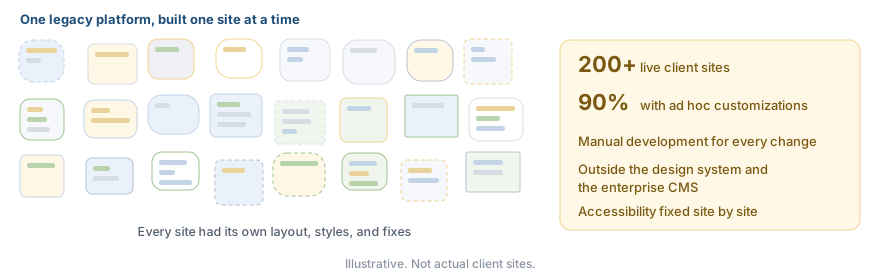
This was a major initiative at Prudential. Its Workplace businesses ran hundreds of cobranded websites for plan sponsors, participants, and employees. Most were built one at a time: 90% carried ad hoc customizations and needed manual development. They sat outside the participant experience, the corporate design system, and the enterprise CMS. More than 200 live client sites sat on one legacy platform. Every change was slow and costly, and keeping hundreds of sites accessible, secure, and compliant was a recurring challenge.
Before
 (opens full size in a new tab)
My role
From about 2018 to 2022, I led the UX effort for the custom client sites and the UI components they shared. Instead of designing each site from scratch, we designed one system that could produce them.
My approach
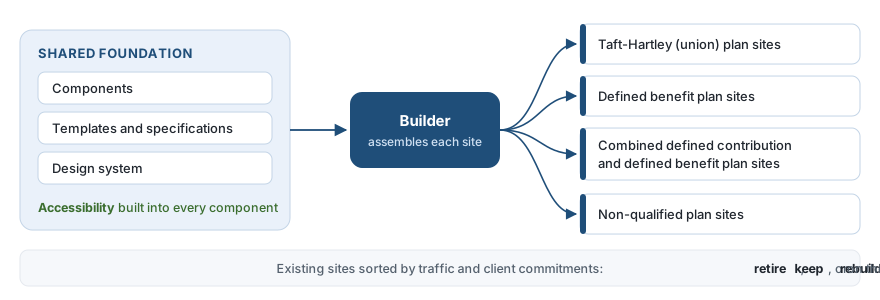
- Designed every component upstream of the build, along with the templates, specifications, and design system the sites were built from.
- Used a decommission analysis to sort sites into retire, keep, and rebuild, so effort went where traffic and client commitments were.
- Built accessibility into all shared components, so every site built from them started on an accessible foundation.
After
 (opens full size in a new tab)
Outcome
My component design contributed to roughly 50% labor savings on applicable work. New Taft-Hartley (union), defined benefit, and combined defined contribution and defined benefit site options no longer needed full customization, and the builder also avoided about $45K a year in PDF remediation.